Hurt in a car accident that wasn't your fault?wasn't your fault? See what your case could be worth.
See what your case could be worth.
Answer 8 quick questions for a free settlement estimate.Even a small accident can count. Answer 8 quick questions and see what cases like yours settle for.
- Hurt in the accident
- Not your fault, or mostly not
- Happened recently
- No attorney yet
- Saw a doctor, or still need to
- Insurance offered too little, or nothing yet
- Happened recently
- No attorney yet
Get your free settlement estimate
8 quick questions. About 1 minute.
Free. No obligation. About 1 minute.Get your estimate and your free Personal Playbook right to your phone.
The insurance company has a team working to pay you less. You need an attorney working to get you more.

The adjuster prices your case on five things. Now you can too.
Your injuries and how long they last. The most serious injury, the treatment it needed, and whether anything is permanent set the base of every case.
Medical bills and future care. Documented treatment is what proves the injury, and it is what everything else is measured against.
Lost income. Missed work, reduced hours, and work you can no longer do are added on top.
Who was at fault. Every state has its own rule for shared fault, and a few bar any recovery if you were partly at fault.
Available insurance. The other driver's policy limit, and your own coverage, decide how much can actually be collected.
Your free estimate in 3 steps. About 1 minute.
Your answers go through the same factors the adjuster looks at first.
- 1
Answer 8 quick questions
Where it happened, your worst injury, your recovery, missed work, fault, and insurance.
- 2
See your settlement rangeGet your settlement range
A low-to-high range built from your answers.A low-to-high range built from your answers, sent right to your phone with your free Personal Playbook.
- 3
Find out where your case falls
Your estimate is a range. One short call with a case advisor matches you with a local attorney who focuses on cases like yours, so your review is about your case, not a guess. No risk. You only pay once you have settlement money in hand.
What was your most serious injury?
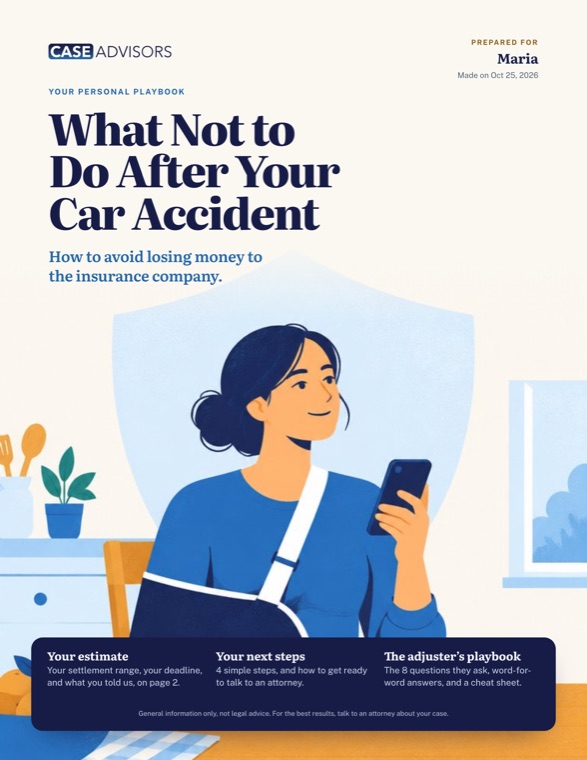
What not to do after your car accident.
Your personal playbook, made for you. Whatever comes next in your recovery, it shows you what to do, and what not to do, so you don't lose money to the insurance company.
- 1
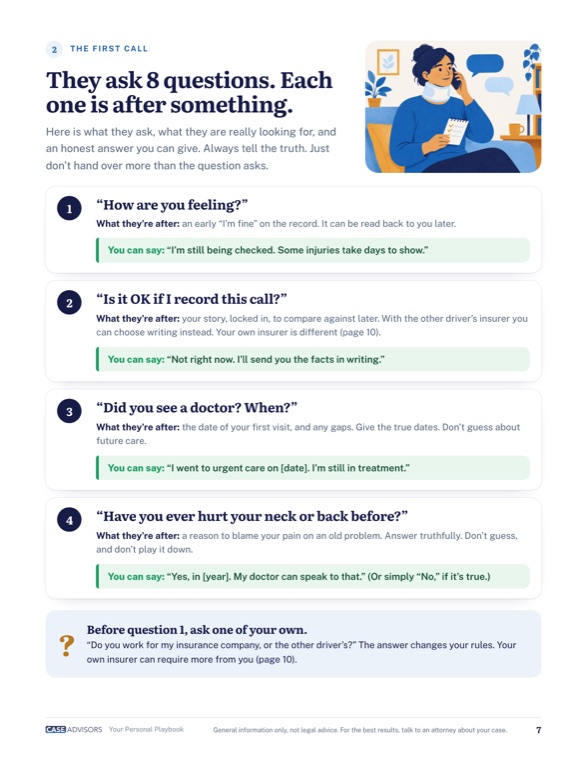
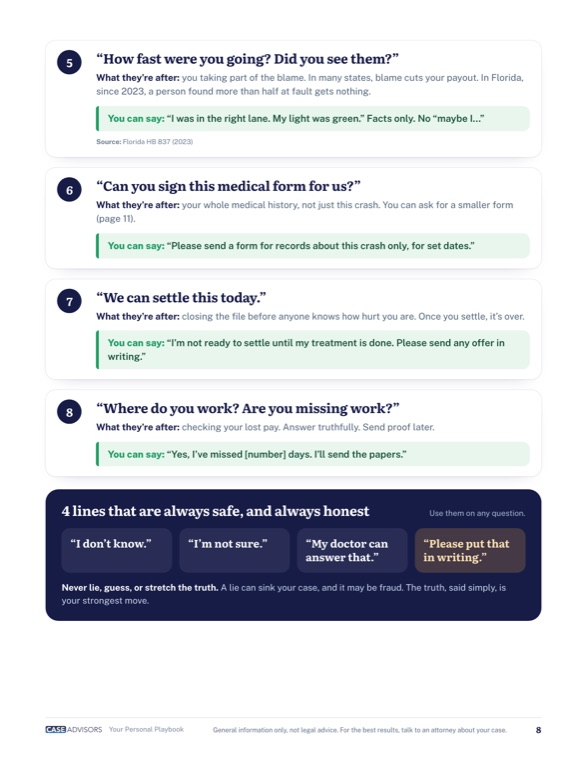
Before the adjuster calls: the 8 questions they ask, and word-for-word answers.
- 2
Before you sign anything: which papers can't be undone.
- 3
Before your deadline: your state's date, in writing.
- 4
Before you meet your attorney: what to bring and what to ask, so nothing gets left out.
- 5
Every day until it's settled: a call log and medical record tips that protect your case.
Sent by text with your estimate. General information only, not legal advice.
Is this for you? A 10-second check.
You may have a case if:
- You were injured and got medical care, or are still treating.
- The other driver was at fault, or mostly at fault.
- The accident is inside your state's filing deadline. Most are 2 to 3 years.
- You were a driver, passenger, rideshare passenger, pedestrian, or cyclist.
Probably not a fit if:
- You weren't injured and didn't need medical care.
- You caused the accident.
- The accident happened more than 2 years ago in most states.
Five ways your case loses value
Most of them happen before you ever talk to an attorney.
A fast offer.
It often comes before you know how hurt you are. Sign it, and your case is closed for good.
A gap in treatment.
Weeks without care get read as "it wasn't that bad." Follow your doctor's plan.
A recorded statement.
What you say on the phone can be used to argue fault. You do not have to give one right away.
Your share of fault.
In most states, 20% at fault means 20% less. In a few states, any fault can mean nothing.
A small policy.
Many drivers carry only the state minimum. Your own underinsured coverage can fill the gap.
They show up with a team. Don't show up alone.
The adjuster calling you works for the company that pays your settlement. Here is who is on your side.
Their side
- An adjuster whose job is to close your case for less.
- Software that puts a price on your injury.
- Attorneys on call to defend the insurance company.
Your side
- A free estimate of what your case is worth, from 8 questions.
- Plain-English guides to the calls, letters, and offers you get.
- A local attorney on your side, before you sign anything.
- No risk. You only pay once you have settlement money in hand.
Average amount car accident victims received, with and without an attorney. That is about 3 times more. People with an attorney were also more likely to get paid at all: 74% vs 54%.
Source: survey reported by Forbes Advisor. Averages before attorney fees.fine for Farmers in 2007. North Dakota said it rewarded adjusters for paying injured people less. Farmers denied it.
Source: Claims Journal, July 2007people hurt by another driver now hire an attorney. Getting help is normal, not greedy.
Source: Insurance Research Council, 2026What an attorney needs to value your case
The estimate needs only your answers. A real valuation needs records. Here is what to gather when you can.
What you may be able to recover
Every case is different and none of these is guaranteed.
Situations that change the math
Short, educational notes. Appearing here doesn't mean a case qualifies.
Questions before you start
Still not sure? The estimate is free, and there's no obligation to do anything after.
How is the estimate built?
Your most serious injury and recovery set a typical range of medical bills. That range is scaled by what insurers have paid on similar cases, and lasting injuries count for more. Lost pay is added. Then your state's fault rule, insurance, and average payments adjust the range.
Is the estimate a promise of what I will get?
No. It is an educational range built from public settlement data. Your real records, the other driver's policy limit, and the facts of the accident decide the actual amount.
What is the average car accident settlement?
It depends on the injury. A soft-tissue case often settles in the low thousands, and a surgery case can run into six figures. In a survey reported by Forbes Advisor, car accident victims with an attorney received $44,600 on average, before fees.
Is it true the settlement is three times the medical bills?
Sometimes. It is a rule of thumb, not a law. Injuries that heal fast often settle for less. Lasting injuries and surgery often settle for more.
What if I was partly at fault?
In most states your share of fault reduces the amount. A few states bar any recovery if you were partly at fault, and others cut you off at 50%. The estimate applies your state's rule.
What are policy limits?
The most the other driver's insurer will pay. Many drivers carry only the state minimum, often $25,000 per person. Your own underinsured motorist coverage can add to it.
What if the other driver has no insurance?
Your own uninsured motorist coverage may pay. Policies and state rules differ, and an attorney can read yours.
I live in a no-fault state. Does that change things?
Yes. Your own policy pays the first medical bills, and pain and suffering usually needs a serious or lasting injury. The estimate accounts for that.
Do people with an attorney really get more?
In a survey reported by Forbes Advisor, car accident victims with an attorney received $44,600 on average. People without one received $13,900. That is about 3 times more, before fees. A survey is not a promise, and every case is different.
How much do car accident attorneys take?
Most work on contingency. There is no fee unless they recover money for you. The fee is usually about a third of the settlement, and it is set in writing before you sign.
How much of my settlement will I keep?
What is left after the attorney's fee, case costs, and any medical bills paid from the settlement. Your estimate shows a typical take-home range after attorney fees.
How long does a car accident case take?
Cases with an attorney took a median of about 440 days to close in the latest industry study. Simple cases settle faster, and a lawsuit takes longer.
Are there deadlines?
Yes. Every state sets a time limit to file, most between 2 and 3 years, and a few are shorter. The estimate warns you when yours may be close.
The insurance company offered me money. Can I still check?
Yes. Many people check before accepting an offer so they understand what the case may be worth first.
What happens after I submit?
A case advisor may call you to go over your estimate and next steps. The call is free. Your information may also be shared with attorneys in your area, and if one thinks they can help, they may contact you.
How is my information used?
It's used to connect you with attorneys based on your location, as described in our Privacy Policy.
Learn more before you decide
Plain-English guides on how cases are valued and what to do in the first weeks after a crash.
The insurance company already decided what to offer you. Find out what your case is worth first.
8 questions. About 1 minute. Get your estimate and your free Personal Playbook right to your phone. No risk. You only pay once you have settlement money in hand.
See my case value